
Starting Late With Money: The Honest Cost, and Three Better Questions
When someone tells me they’re starting with money later than they meant to, they almost never begin by asking what they should invest in.
The question underneath is usually simpler, heavier and much harder to say out loud:
Is there still any point?
The answer is yes. But I don’t think pretending time doesn’t matter helps anyone. I want to answer the question honestly - including the part that starting late really does cost you.
What starting late really costs
Let’s deal with the uncomfortable bit first, because most encouragement aimed at people who feel behind skips it entirely.
Time you didn’t spend building wealth is time you cannot buy back. That isn’t a mindset problem. It’s arithmetic.
Starting later than you meant to genuinely changes what may be achievable compared with a version of you who started earlier. Anyone telling you otherwise either isn’t thinking about it properly or is trying to sell you something.
But “worse than it could have been” and “pointless” are not the same thing.
That distinction matters. When people quietly collapse the two together, they often decide there is no point looking properly, changing direction or beginning now.
Where you are is information, not a verdict
People have a habit of treating their current financial position as a judgement.
They see it as evidence of who they are, what they’re capable of and what they’re allowed to expect from the rest of their life.
It isn’t a verdict. It is information.
Some of how you arrived here was within your control. Some of it very much wasn’t: the economy you entered, what your work paid at the time, who needed caring for, what happened to the housing market or what life required from you while you were trying to build something.
Both things can be true at once.
You can take responsibility for the decisions that belong to you without making yourself responsible for circumstances you never chose.
Treating your position as a personal failure also has a practical cost. It makes you avoid the numbers because looking at them feels as though it will confirm the verdict.
But you cannot make a useful decision about a position you refuse to look at.
A decision can stop being right
I’ve done this myself, so this isn’t theoretical.
I was on a legal path. I had the degree, but I didn’t complete the rest of the route because real life intervened in a way that made continuing genuinely impractical—not merely difficult.
For a long time, I carried that as something I had failed at rather than a direction I had changed.
That is the trap sunk cost creates. You keep paying for an old decision because of everything it has already cost you. Then the price of changing your mind increases every year you refuse to reconsider it.
Changing direction is not automatically failure. Sometimes it is the only honest response to information you didn’t have when you made the original decision.
And this isn’t only about money.
It happens in careers people remain in long after they stop fitting. It happens in places people moved to for reasons that no longer apply. It happens in businesses designed around a version of life that has since changed.
Ask a better question
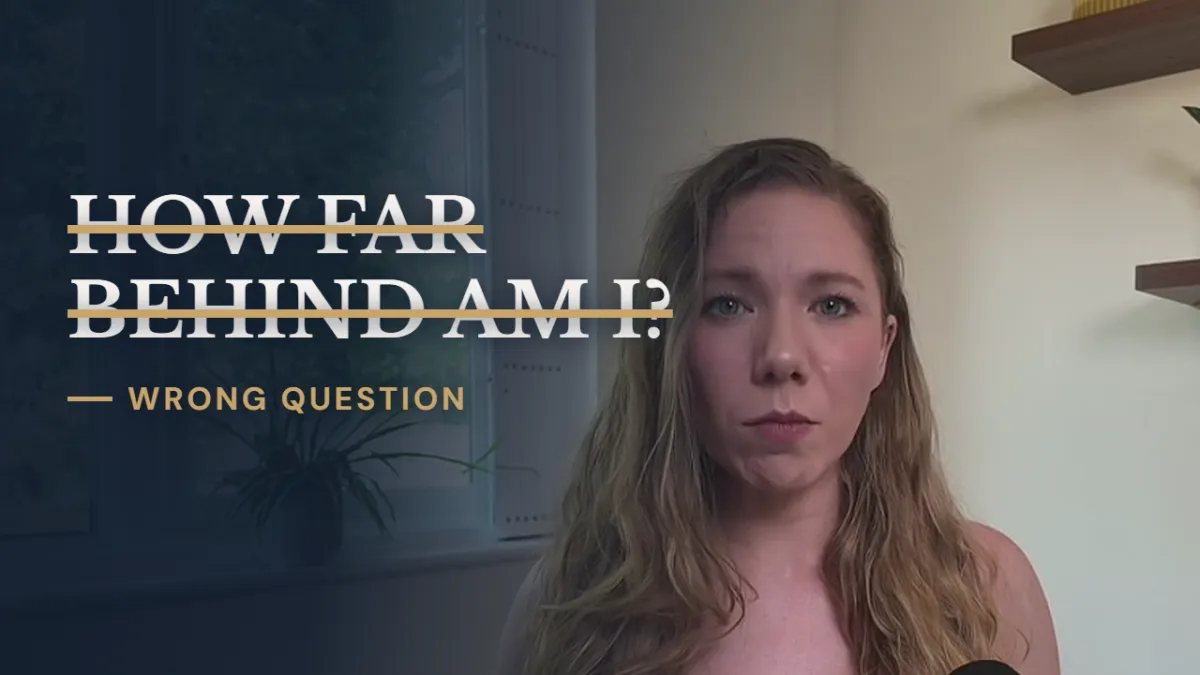
“How far behind am I?” is usually the wrong question.
Behind whom?
According to whose timeline?
And what answer could anyone give you that would leave you better equipped to make your next decision?
The question I would replace it with is:
What freedom can I build from here?
Not from where you think you should have been. From here—with the actual numbers, circumstances, responsibilities and opportunities you have now.
Three questions to answer tonight
That is a big question, so start with three smaller ones. The order matters.
1. What is actually true right now?
Not the rounded-up version. Not the version you would say to someone you wanted to impress.
What is genuinely coming in? What is genuinely going out? What do you owe? What do you own?
This is the question people most often skip, which is precisely why everything after it remains vague. You cannot make a reliable plan from an estimate you are avoiding checking.
2. What can I still change?
Some parts of your position are fixed. Others aren’t.
Look at your income, your outgoings, what you’re tolerating, what you’ve been postponing and the assets, knowledge or skills you already have but aren’t using.
You may have fewer options than you would ideally like. That does not mean you have no options.
3. What am I actually trying to build?
This one sounds soft. It isn’t.
If you don’t know what you’re optimising for, you can make technically sensible decisions and still end up somewhere you never wanted to be.
A number that means nothing to you is not a meaningful target. It is probably a borrowed one.
Where to start
If your answer to the third question is currently a bit fuzzy, that is normal.
It is also why I created the Freedom Audit. It takes you through a broader set of questions designed to help you define what freedom actually means in your life before you begin optimising everything towards it.
It is a clarifying exercise. It will not produce a financial projection or pretend to hand you a perfect plan. It will help you see what you are genuinely trying to build.
Starting later costs something real. I won’t pretend otherwise.
But the time already gone does not get to make your next decision for you.
This article is for education and general discussion. It is not personalised financial advice.